Chapter One
Accept Your Emotions and Take Responsibility for Your Actions
Central ideas in this chapter
- Divorce is an exhausting upheaval in a life.
- Intense emotions challenge your ability to think clearly.
- Maybe you are overwhelmed by emotions — or you avoid them.
- Take responsibility for your own emotions and actions.
This chapter deals with how you can handle the difficult emotions involved in a divorce. It's important for the well-being of your children and yourself that you find a way to stay calm when under pressure. This is also important when you have to work together with your children's co-parent.
Even though divorce has become widespread and common, it feels anything but normal to the adults and children going through it. Divorce is a demanding upheaval in people's lives, and it involves a lot of time and energy. For most people, divorce unleashes many distressing emotions that have to be dealt with. Sidsel and Benjamin's story is a good example.
Sidsel and Benjamin
Sidsel and Benjamin had a baby, and from day one it was extremely rough on them; their little boy had colic and cried all day long. They grew more and more exhausted, and unfortunately their network wasn't broad or tightly-knit; they had no one close by who could step in and relieve them. Sidsel yelled at Benjamin because she didn't think he was doing his fair share. He felt she was way out of line and unfair to him, that she was overlooking how much he was doing to keep the family afloat. Sidsel and Benjamin's breakup was difficult.
Benjamin had had a clandestine affair with a co-worker. Sidsel found out about it when she happened to notice the emails between them. She then threw Benjamin out of their rental apartment, of which she was the primary tenant. To begin with, he wasn't allowed to see their son, because he had betrayed her and the baby. Sidsel was enraged, hurt, and very unhappy. Benjamin was embarrassed; he felt guilty, but he was also a bit relieved about no longer having to keep his secret.
Divorce is a Major Upheaval in Our Lives
For most of us, a divorce seriously disrupts our lives, and for many it becomes a crisis. The processes that people go through with death and divorce are similar in many ways, but they also differ in one important aspect. When someone close to us dies, that person is no longer physically present. With divorce, our former partner is still around, and we have to cooperate with him or her when our children are involved. We become emotional during shared activities, on exchange days when the children leave to stay with the other parent, and when joint decisions concerning the children have to be made. Many people experience the time just after a divorce as especially challenging, and when our former partner finds someone new, emotions can erupt again.
Especially in the first few years after the divorce, Sidsel missed her son terribly when he was staying with Benjamin. She was deeply affected by the very chilly atmosphere between her and Benjamin on exchange days. It's natural and understandable that divorcing someone we were close to and with whom we have children is an enormously emotional experience. At times, our emotions run away with us.
Intense Emotions Make it Difficult to Think Clearly
When we're in the grip of emotion, our ability to think clearly and make rational decisions can suffer. A divorce is particularly challenging in its first phase, because we're in a state of crisis. And when that happens, we can believe that our emotions and reality are the same thing. For example, when we are angry at our ex and hurt because of the divorce. This is of course particularly likely if an affair is involved.
Sidsel was hurt and angry about Benjamin cheating on her and lying to her so many times. She threw him out, and he was not allowed to see the baby. She was overwhelmed by tormenting emotions, and she told her friends that Benjamin was a psychopath who was damaging both her and her child. She felt she had no choice but to keep their child away from him. Sidsel's anger and distress left her unable to distinguish between Benjamin as her ex and his role as the father of their child.
If we only listen to our emotions, we tend to generalize. A person is either good or bad; there are no gray areas, no nuances. That's how Sidsel felt: Benjamin is a bad husband, and therefore he's a bad father for our child, so I have to protect my boy from him as much as possible. This is how intense emotions stand in the way of making sensible choices. They can blind us to the needs of our children. Sidsel and Benjamin's son was still happy spending time with his father, and he needed a strong, healthy relationship with him. Sidsel pulled herself together, and after a short time she realized that her son needed to see his father.
The Emotional Window of Tolerance
Whether it comes from within ourselves or from others, emotional pressure makes controlling our emotions difficult. When we are in a state of harmony and feel strong and energetic, however, emotional pressure is much easier to deal with. To understand how this works, try examining your emotional window of tolerance. When you are inside the window's frame, you are calm and can separate your thoughts from your feelings. You can listen to what your co-parent is saying and decide whether or not you agree. You can have a constructive conversation.
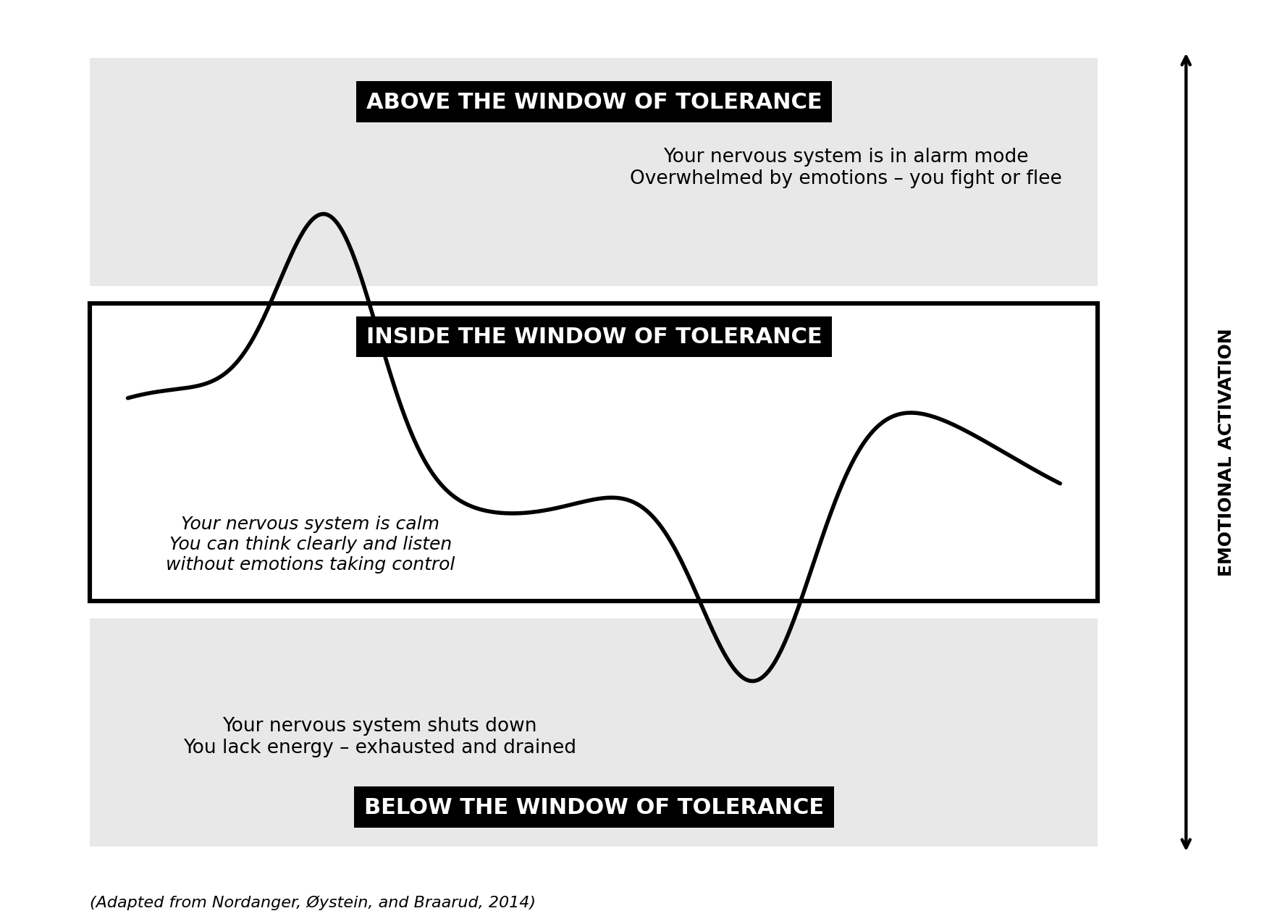
When you experience heavy emotional pressure over a long period of time, you rise above the window. That is, your nervous system is activated, and you feel physical discomfort and irritation, perhaps. Suddenly you can't distinguish your thoughts from your emotions, and the latter end up controlling you. You hardly hear what the other person is saying; instead of listening, you're thinking of how to respond. You might even shut down and break off the conversation and walk away, because you feel so bad.
It's particularly challenging when you find yourself in situations you have no control over. A divorce you didn't choose can be very tough to take. Your physical and emotional foundation is also under pressure, because the divorce has consequences for your relationship with your ex, your children, your network, your house or apartment, and your financial situation.
No matter what, you'll have your own unique way of reacting.
Therefore, it's natural that you react emotionally. Your nervous system is in alarm mode, because the foundation of your life is changing. You probably feel unsettled and anxious, that everything around you seems chaotic. You might become overwhelmed by rage, hurt, sorrow and loss. You might also feel a sense of relief and guilt.
The emotional window of tolerance differs from person to person. It's deeply embedded both in your genes and in the caregiving climate you experienced when you were a child. Try thinking about what your own window of tolerance looks like. When are you calm and in a state of harmony? When do you lose control of yourself? What triggers this loss of control?
Do You Fight or Flee?
When you are under emotional pressure for a long time, you react by using one of the basic human survival strategies: you either fight or flee.
When you choose to fight, you're protecting yourself emotionally. As a child you might have found that if you fought long enough, you were seen and understood. You might yearn for the other person to do just that, to see and understand you.
Choosing to flee is another way to protect yourself. You might have learned that you can best shield yourself from distressing emotions by trying to avoid them, by running away from them. But the energy you use in escaping from your emotions drains you, and your nervous system is activated anyway.
This extra pressure on your emotions strains your ability to keep calm and restricts your tolerance window. Your fuse is shorter, while the risk of exploding with rage or running far away increases.
Sidsel chose to react by attacking and fighting. She pushed Benjamin out the door after he'd packed a suitcase. Benjamin backed off, and several days went by before he contacted her again. He missed his son, and his son missed him. The fact was that he'd often avoided conflicts over the years. Usually, he'd turned silent and pulled away whenever Sidsel got angry.
These reactions are completely normal. According to attachment theory, how a person reacts is formed in childhood, during which survival strategies for handling emotional pressure are developed. The risk of someone not taking care of their emotions is that their tolerance window becomes smaller.
If you have been stressed out for quite a while, you run the risk of collapsing emotionally if you don't take care of yourself. Being trapped in your emotions demands a great deal of energy from your nervous system. When you find you can't flee or fight your way out of the situation you're in, you may feel helpless and incapable of making a decision. You don't have the energy to go on, and you might even become depressed if you don't receive enough support from your network or get professional help. This is why it's important to find various ways of taking care of yourself (see Chapter 3). It's also important to emphasize that nearly everyone recovers quickly when they receive support; their crisis lasts only a short while.
Sidsel broke down emotionally after a few months of intense anger and pain. Benjamin and Sidsel went into couples therapy, to decide if they could get back together, or if they should try for a good working relationship after their divorce. They chose the latter. After the decision was made, Sidsel fell apart again for a while. She felt helpless, empty. But with the help and support of her network, she soon got back on her feet.
Two Paths for Working Through a Crisis
Divorce can be seen as a grief and crisis situation. The newest research in this area describes two paths for working through a crisis (Schut and Stroebe, 2010). One leads into the past, one into the future; the former is about dealing with loss, the latter focuses on building a new life. It's important that the process switches between the two paths, because this makes it easier to get through a crisis.
Why is it that some parents can handle the crisis and end up just fine, while others can't? There are various explanations for this, depending on the individual. How you were treated as a child when you were unhappy is definitely a part of it, but only a part. Generally, it can be said that the better the role models you've had for handling a crisis, the easier it is for you to ask for help when you need it.
Your ability to deal with stress and crises is only one factor. Among others are: how did the breakup happen? What are the challenges in connection with the divorce? How are the children reacting? Are there other things causing you stress? What are your options for seeking support in your network?
It was particularly difficult for Sidsel to deal with Benjamin's infidelity, but fortunately she had some good girlfriends who helped support her emotionally when she crashed. It was a different story for Benjamin. He soon got on with his life and moved in with his new girlfriend. She got pregnant, and his life primarily revolved around his new family. He had very little to do with Sidsel, and he seldom talked about her with their son.
Take Responsibility for Your Own Emotions and Actions
An important part of the work of getting through a divorce is taking responsibility for your behavior toward your ex. First, it's important to consider how you react when you're under pressure. Do you tend to run away when the going gets rough, or are you more likely to fight? No matter what, it can be good to get away from what you usually do, to try something different. It's completely okay to need some distance from your ex for a while, to have time to do some necessary thinking and to take care of yourself, as long as you cooperate to create consistency and compatibility in your children's lives in two homes. Here are three suggestions to help you with this process:
First, be aware of your physical reactions when you're about to lose your temper. Do you feel it in your stomach, in your head? Do you clench your fists? What causes this reaction? Do you walk off, or do you get mad and go for the attack?
Secondly, recognize the situations where your emotions are most intense, so you'll know when you're about to get worked up. In this way you can learn what situations or what things your ex does that push your buttons.
Finally, be aware of the things you do that make your ex explode. Can you act or speak in a different way, so you don't fall into a negative pattern of interaction with them?
When you have to work together with your co-parent, it's important to give them — and yourself — space, while you're both checking out how you feel and how to react to the emotional pressure you're under. Here it's also totally okay to pull back for a while. You need to take care of yourself and give yourself time to deal with your reactions. Likewise, it's important to give your co-parent the same consideration. In this way you can each take responsibility for your part in the negative pattern.
In many ways we are role models for our children when it comes to how to handle a crisis in our lives. Children can handle a difficult and demanding period, as long as things turn out okay.
For a while Sidsel needed to see a therapist, to help her calm herself down when things got difficult between her and Benjamin. Meanwhile, he was having a hard time cooperating with Sidsel. While on sick leave because of stress, he became aware of how much of a burden working with her was, so he also began seeing a therapist. The sessions helped him to talk about the difficult thoughts and emotions he'd been carrying around inside.
Questions to ask yourself
- How do you react when you are under emotional pressure? Do you flee, or do you fight?
- What is it your ex does that sets off your most extreme emotional reactions?
- What do you do that sets off the most extreme emotional reactions in your ex?
- What strategies do you have to calm yourself down when you're under emotional pressure?
End of Chapter One
Chapter one complete
You've just read chapter 1. Your kids are worth the other nine.
-
2 · Find a realistic level of cooperation
Not every ex can be a co-parenting partner. How to find the level that actually works for the two of you — and stop trying for one that doesn't.
-
3 · Take care of yourself
Why you cannot carry your children through this if you are running on empty, and what that care looks like in practice.
-
4 · Create your new life
The identity you had was built for two. How to build one that is yours — without rushing, and without waiting for permission.
-
5 · Be adequate parents, each in your own way
You will not parent the same way. You don't have to. What children need is two good-enough parents, not two identical ones.
-
6 · Give your children what they need
What they are actually asking for, at every age, and the words that help when they ask the hard questions.
-
7 · Get support from your network
Friends and family take sides, disappear, or say the wrong thing. How to ask for the help you need and let go of the rest.
-
8 · Seek help when it becomes difficult to cooperate
When talking no longer works: mediation, therapy, and how to tell the difference between a hard phase and a real problem.
-
9 · Maintain a good working relationship
Years later, at the graduations and the weddings, this is the chapter that pays off.
-
10 · When other circumstances are at stake
New partners, moving, illness, addiction, violence. The situations where the ordinary rules do not apply.
Ten chapters. Written by a psychologist who has sat with divorcing families for twenty-three years. Finalist, 2021 Chanticleer International Book Awards.